Free sample · first 11 of 104 pages
Look Listen Play
Trombone for Students
A colorful practical beginner workbook

Hold • Breathe • Move the slide • Play
NISMCAA | Book 11
B-flat tenor slide trombone in concert-pitch bass clef
Your trombone journey
The trombone can sing a melody, support a band and make a bright or warm brass sound. You will learn to hold it comfortably, make clear notes, guide the slide and create a short tune.
Learn with a music teacher or a helpful adult. Pictures show playing situations; precise position numbers and staff maps guide the notes. Learn in small steps and rest often.
My name: __________________________________
My school: __________________________________
My teacher: _________________________________
My first goal: _________________________________
How to use your book
1. LOOK at the visual and find the same part or slide position.
2. TRY the teaching steps slowly with your teacher.
3. LISTEN for the sound described.
4. PRACTICE the facing page and show what you learned.
Use short attempts with rests. Stop for pain, dizziness or discomfort. A teacher can adapt grip, instrument size, range and slide reach. Long-position tasks may be listening tasks until you are ready.
Your lesson route
Each lesson has a teaching page and a practice page. Tick a lesson when you can demonstrate its skill.
○ 01 Meet the trombone · 9
○ 02 Find a comfortable instrument · 11
○ 03 Learn the trombone parts · 13
○ 04 Assemble with an adult · 15
○ 05 Support with the left hand · 17
○ 06 Move with the right hand · 19
○ 07 Stand and sit comfortably · 21
○ 08 Breathe for a musical phrase · 23
○ 09 Make a gentle mouthpiece sound · 25
○ 10 Make your first full sound · 27
○ 11 Keep a steady pulse · 29
○ 12 Learn low B flat · 31
○ 13 Start a note gently · 33
○ 14 Make a quiet rest · 35
○ 15 Understand slide positions · 37
○ 16 Find F above low B flat · 39
○ 17 Begin a gentle lip slur · 41
○ 18 Find D in fourth position · 43
○ 19 Find E flat in third position · 45
○ 20 Find E natural in second position · 47
○ 21 Play a three-note tune · 49
○ 22 Hold two-beat notes · 51
Reference and writing pages begin on page 97.
Your next lessons
Each lesson has a teaching page and a practice page. Tick a lesson when you can demonstrate its skill.
○ 23 Play even eighth notes · 53
○ 24 Read your first bass-clef notes · 55
○ 25 Understand flats and naturals · 57
○ 26 Find C in sixth position · 59
○ 27 Find D flat in fifth position · 61
○ 28 Explore seventh position · 63
○ 29 Find a higher G · 65
○ 30 Find a higher A · 67
○ 31 Find the next B flat · 69
○ 32 Build a B flat major scale · 71
○ 33 Listen and adjust your pitch · 73
○ 34 Coordinate slide and tongue · 75
○ 35 Connect a smooth phrase · 77
○ 36 Play soft and a little stronger · 79
○ 37 Plan a musical breath · 81
○ 38 Echo and remember · 83
○ 39 Compose your own tune · 85
○ 40 Play with a partner · 87
○ 41 Prepare a short performance · 89
○ 42 Care for your trombone · 91
○ 43 Solve one playing problem · 93
○ 44 Choose your next goal · 95
Reference and writing pages begin on page 97.
See the playing position
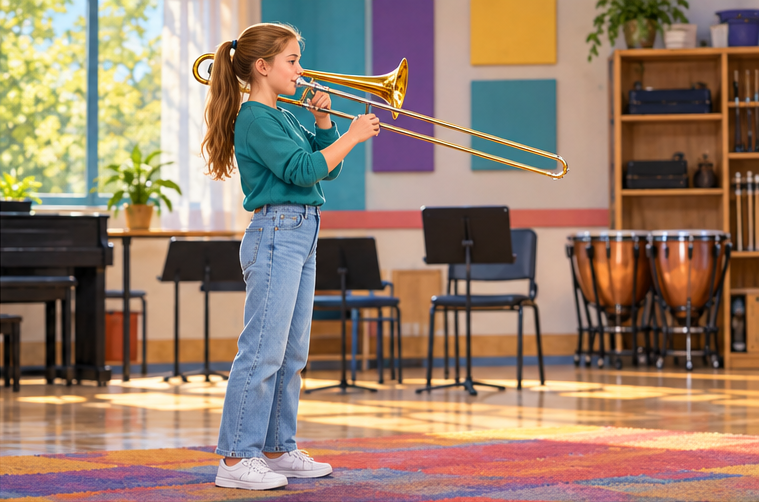
SIDE VIEW: feet balanced, shoulders relaxed and the mouthpiece brought gently to the lips. Keep the whole slide path clear.
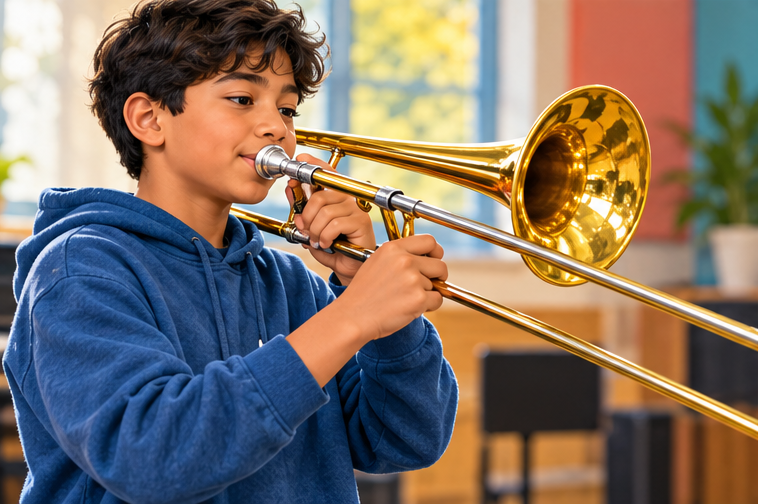
HAND VIEW: the left hand supports the fixed brace; the right hand guides the moving slide brace. Ask your teacher to check both grips.
Meet your instrument
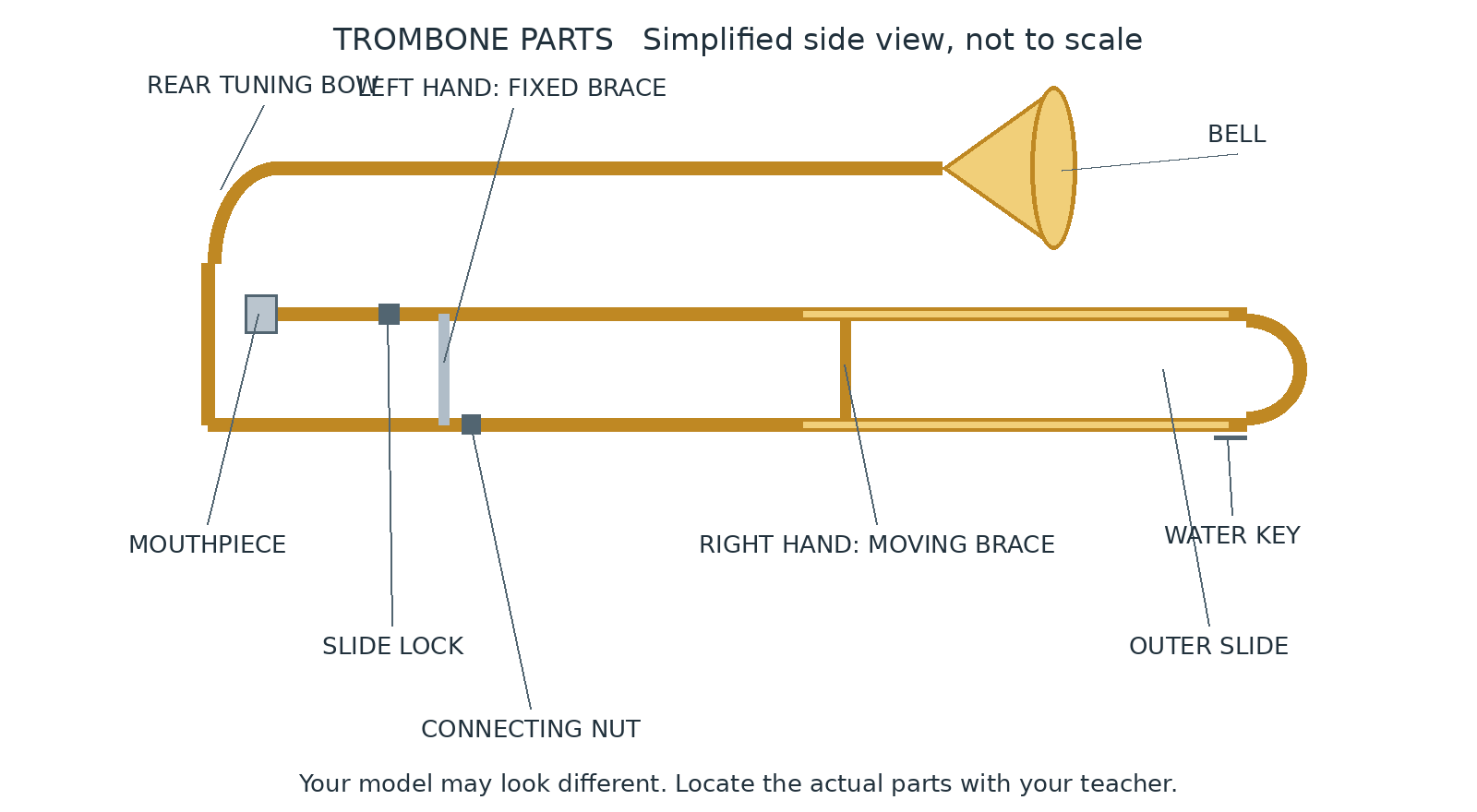
The mouthpiece leads into the slide tubing. Air travels through the instrument and out of the bell. The moving outer slide changes the tube length.
The diagram shows a simple tenor trombone. If yours has a valve, a teacher must explain its separate positions and controls. This book’s numbers assume no valve is used.
Read your visual maps
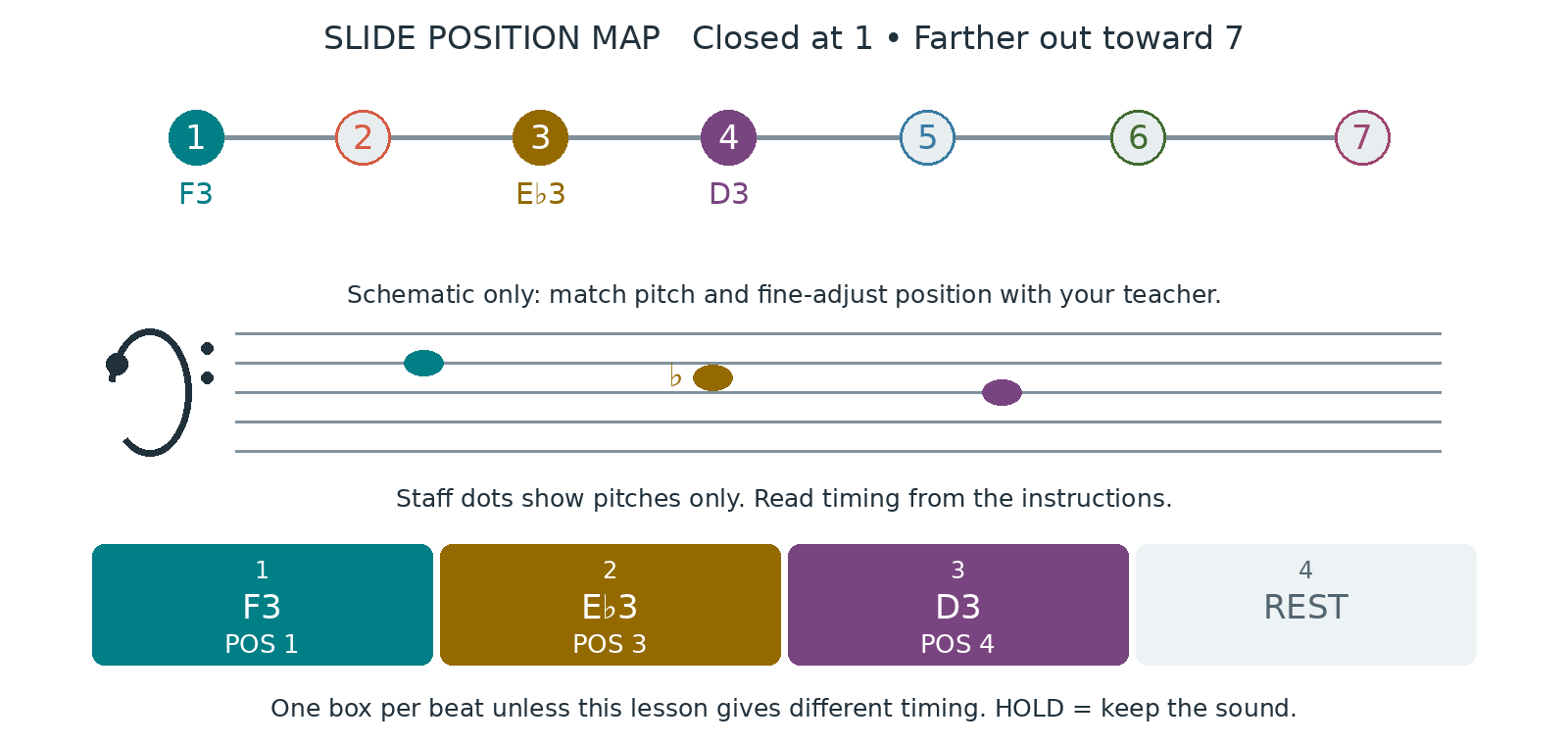
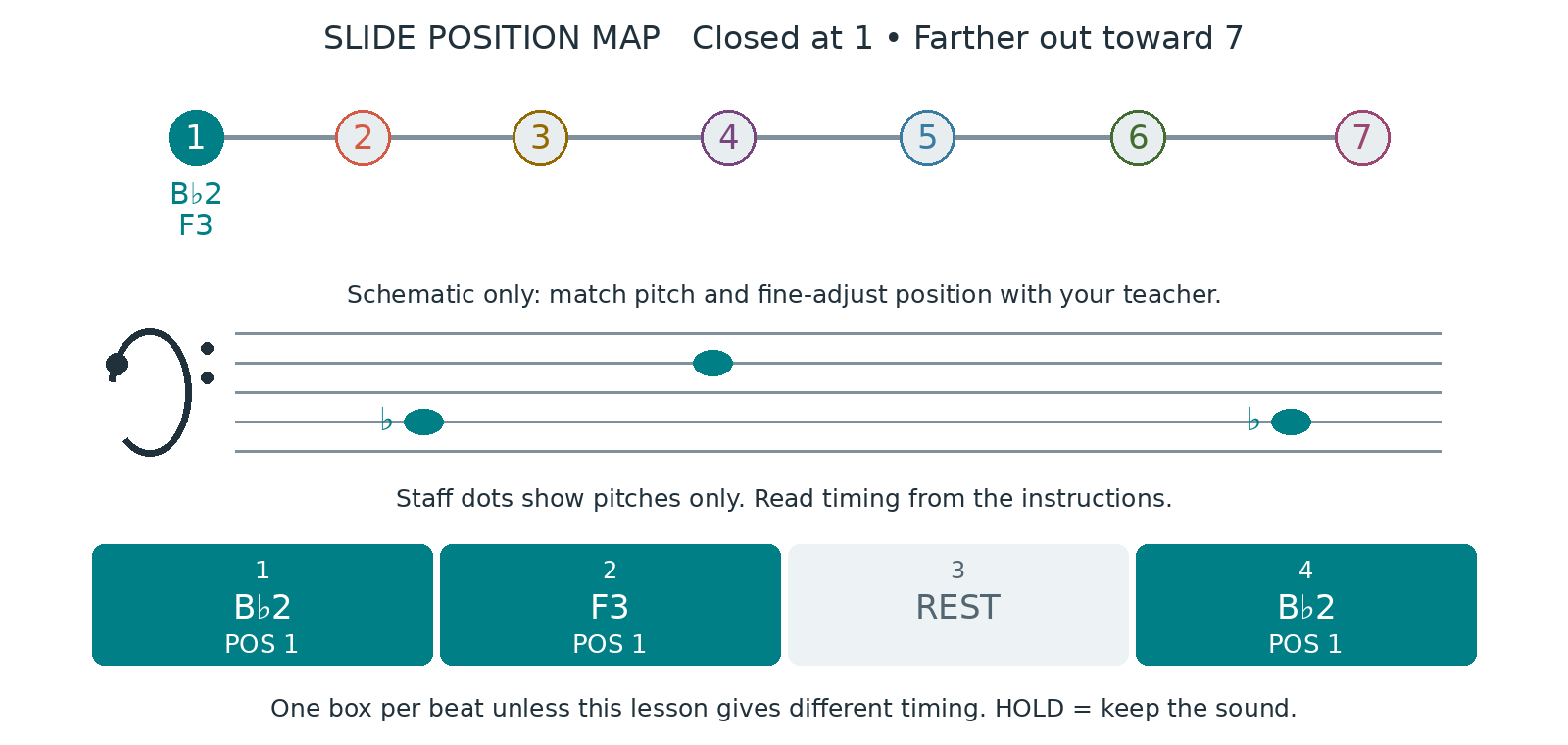
1. The upper circles are slide positions, from closed 1 outward to 7.
2. The staff dots show pitch only
3. the boxes below give note order.
4. Matching colors connect a note box to its slide position. REST is silence.
B♭ means B flat, E♭ means E flat, and D♭ means D flat. Octave numbers distinguish low and high notes; they are not positions. The same position can produce several notes.
LESSON 01 • LOOK AND TRY
Meet the trombone
Discover a brass instrument with a moving slide.
1. Listen to your teacher play a short trombone phrase.
2. Notice the mouthpiece, bell and long slide.
3. Clap the beat while your teacher repeats the phrase.
Listen: A warm brass sound with a clear musical shape.
Check: ask your teacher to check the pitch, slide control and your comfort.
LESSON 01 • PLAY AND CHECK
Try it yourself
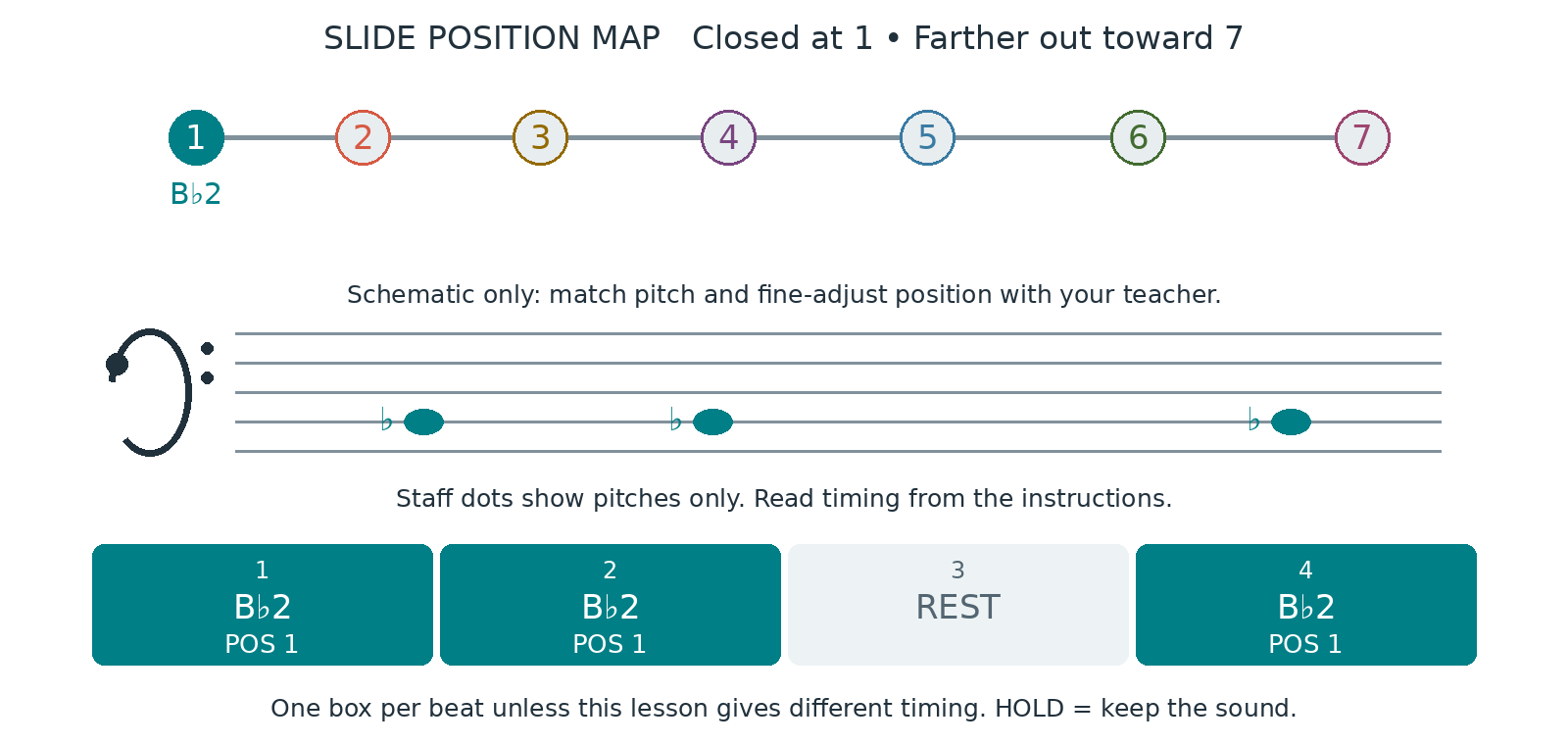
1. Describe the sound in your own words.
2. Point to the slide without touching it.
3. Clap four equal beats and echo your teacher.
Ready for more? Explain how the trombone could join a school band.
School connection: Naming parts and describing sound practices clear language.
○ I tried it ○ I can show it ○ I want help
One thing I noticed: __________________________
My next small step: ___________________________
LESSON 02 • LOOK AND TRY
Find a comfortable instrument
Choose a trombone that suits your reach.
1. This book uses a B-flat tenor slide trombone without a valve.
2. Ask a teacher to check weight, balance and your comfortable reach.
3. A suitable compact or adapted instrument may help a smaller player.
Listen: Your teacher demonstrates notes you cannot yet reach.
Check: ask your teacher to check the pitch, slide control and your comfort.
End of your free sample
You have read the free sample of Trombone for Students (11 of 104 pages).
Buy the complete book as a PDF download for $7.99 (USD). Secure checkout with Stripe; your download opens right after payment and a receipt is emailed to you.