Free sample · first 3 of 27 pages
Read the page text
NISMCAA • MUSIC FOR EVERY CHILD • TEACHER
1
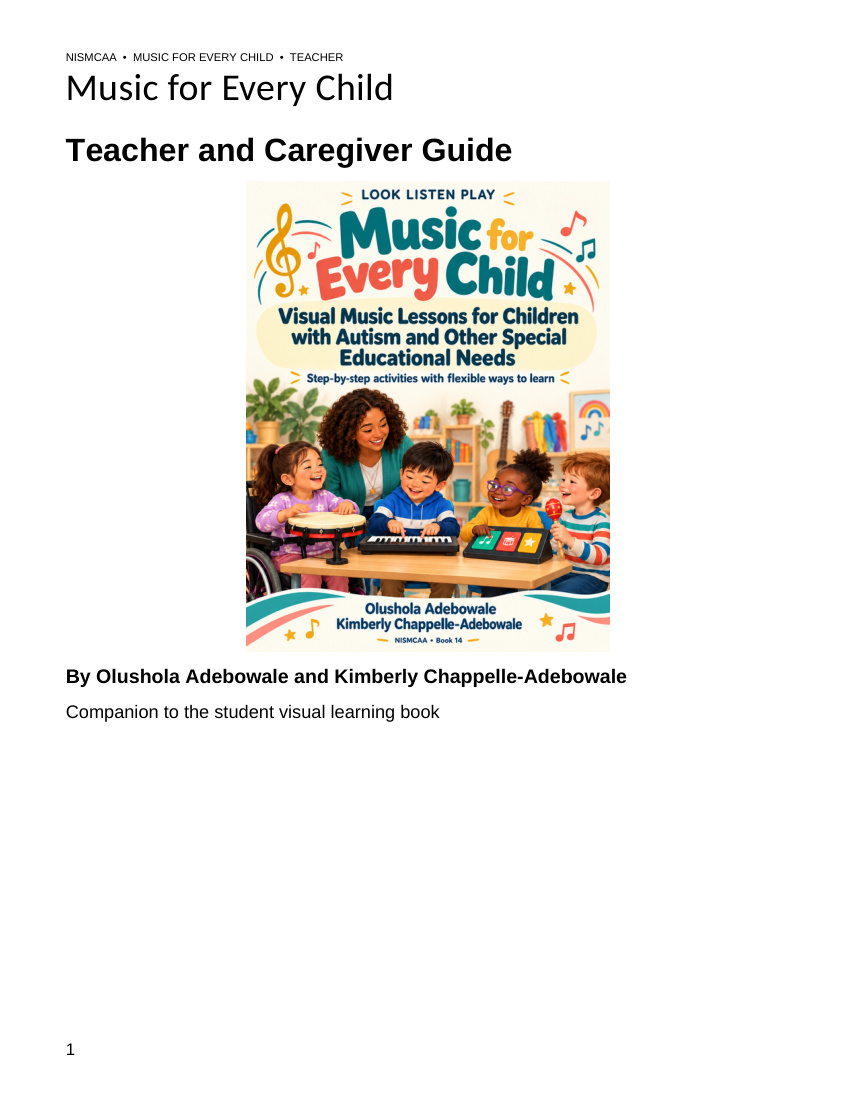
Music for Every Child
Teacher and Caregiver Guide
By Olushola Adebowale and Kimberly Chappelle-Adebowale
Companion to the student visual learning book
Read the page text
NISMCAA • MUSIC FOR EVERY CHILD • TEACHER
2
Use the student book with a learner
This guide accompanies the picture-led student book. The student pages use large illustrations,
labeled sequences and short prompts. This guide holds the demonstrations, access options,
practice suggestions and observation records.
Read or describe a student picture, model one musical action and offer the learner a chosen way
to respond. A response can be playing, pointing, gaze, movement, a familiar gesture or an
established communication aid.
Use the lessons flexibly. Progress depends on a meaningful musical action and useful access,
not finishing every page or matching another child’s pace. Agree support with the child, family
and relevant teaching team.
The activities are educational examples. They are not a treatment program. Illustrations are
examples of participation rather than universal setups.
Student navigation
01 Choose your music • student pages 7 and 8
02 My start and stop signals • student pages 9 and 10
03 Sound and silence • student pages 11 and 12
04 Four steady beats • student pages 13 and 14
05 Play and rest • student pages 15 and 16
06 The drum sounds once • student pages 17 and 18
07 Shake and wait • student pages 19 and 20
08 Echo my rhythm • student pages 21 and 22
09 My turn and your turn • student pages 23 and 24
10 Higher and lower sounds • student pages 25 and 26
11 Find C on the keyboard • student pages 27 and 28
12 Three keyboard notes • student pages 29 and 30
13 My voice or my signal • student pages 31 and 32
14 Move with the beat • student pages 33 and 34
15 Write a four beat piece • student pages 35 and 36
16 Share our music • student pages 37 and 38
Read the page text
NISMCAA • MUSIC FOR EVERY CHILD • TEACHER
3
Prepare the space and instruments
Ask about preferred sounds, communication, comfortable positioning and breaks. Follow the
learner’s existing support arrangements. Use a stable surface, accessible clear routes and
instruments within comfortable reach.
An adult checks sealed percussion is intact and supervises equipment. Avoid small loose parts
and keep instruments away from ears. Preview an unfamiliar sound gently with permission. Stop
if sound or movement is uncomfortable.
Do not move a child’s body or guide their hands without their agreement. Start with modeling and
agreed prompts. Follow existing positioning advice for mobility equipment; seek relevant support
for grips or mounts instead of improvising restraints.
What to prepare
Stable hand drum, intact sealed shaker, optional keyboard at a gentle volume, agreed play and
stop cues, accessible sound and rest symbols, and a way to request help or a break. Choose
only the equipment needed for the current activity.
A flexible session
Welcome and choice → model one action → one or two attempts → break → familiar ending. The
child can end after one useful action. Change the duration and pace to suit the learner.
Before starting, confirm the child’s yes, no, stop, help and break signals. A pause or refusal is
information about the activity or access, not a reason to force participation.
End of your free sample
You have read the free sample of Music for Every Child Teacher and Caregiver Guide (3 of 27 pages).
Buy the complete book as a PDF download for $9.99 (USD). Secure checkout with Stripe; your download opens right after payment and a receipt is emailed to you.