Free sample · first 11 of 104 pages
Look Listen Play
Drums and Percussion for Students
An illustrated beginner workbook
Hold • Count • Listen • Play
NISMCAA | Book 3
Your drumming journey
Start with a quiet pad and a steady beat. Learn to control sticks, coordinate hands and feet, play simple grooves and join other musicians. This book focuses on drum kit, with first steps on classroom percussion.
Use it with a music teacher or helpful adult. Illustrated scenes show general playing situations. Numbered diagrams and rhythm grids show the exact exercise.
My name: __________________________________
My school: __________________________________
My teacher: _________________________________
My first goal: _________________________________
How to use your book
1. LOOK at the diagram and find the same instrument parts.
2. COUNT the rhythm before playing it.
3. TRY the numbered steps slowly and listen.
4. PRACTICE the facing page and show your teacher.
Use hearing protection for loud drumming, take quiet breaks and keep practice volume comfortable. Stop if playing hurts. A teacher can adapt tasks and positions for your needs.
Your lesson route
Each lesson has a teaching page and a practice page. Tick it when you can show its skill.
○ 01 Meet the drum family · 9
○ 02 Protect your hearing · 11
○ 03 Choose sticks and a pad · 13
○ 04 Sit at the kit · 15
○ 05 Hold sticks with matched grip · 17
○ 06 Let the stick rebound · 19
○ 07 Find the playing area · 21
○ 08 Keep a steady pulse · 23
○ 09 Alternate the hands · 25
○ 10 Leave a quiet rest · 27
○ 11 Read a rhythm grid · 29
○ 12 Fit two strokes into a beat · 31
○ 13 Practice single strokes · 33
○ 14 Practice double strokes · 35
○ 15 Try a single paradiddle · 37
○ 16 Make gentle accents · 39
○ 17 Play soft and medium · 41
○ 18 Find the snare drum · 43
○ 19 Find the bass pedal · 45
○ 20 Keep the hi hat closed · 47
○ 21 Join bass and hi hat · 49
○ 22 Join snare and hi hat · 51
Reference and writing pages begin on page 97.
Your next lessons
Each lesson has a teaching page and a practice page. Tick it when you can show its skill.
○ 23 Play a first complete beat · 53
○ 24 Play an eighth note beat · 55
○ 25 Change the bass pattern · 57
○ 26 Move the pulse to the ride · 59
○ 27 Explore the toms · 61
○ 28 Play a one beat fill · 63
○ 29 Play a two beat fill · 65
○ 30 Add a crash carefully · 67
○ 31 Count three beat groups · 69
○ 32 Fit four strokes into a beat · 71
○ 33 Play body percussion · 73
○ 34 Play a shaker · 75
○ 35 Play a tambourine · 77
○ 36 Try a hand drum · 79
○ 37 Make a rhythm answer · 81
○ 38 Build a small ensemble · 83
○ 39 Write an original drum groove · 85
○ 40 Follow a song structure · 87
○ 41 Practice with one goal · 89
○ 42 Care for drums and percussion · 91
○ 43 Prepare a school performance · 93
○ 44 Show your progress · 95
Reference and writing pages begin on page 97.
See the playing position
Side view: a stable stool, relaxed shoulders and reachable drums and pedals. Ask an adult to adjust the kit.
Grip view: both hands guide the sticks with a gentle hold. Use teacher demonstration to check your own grip.
Find the kit parts
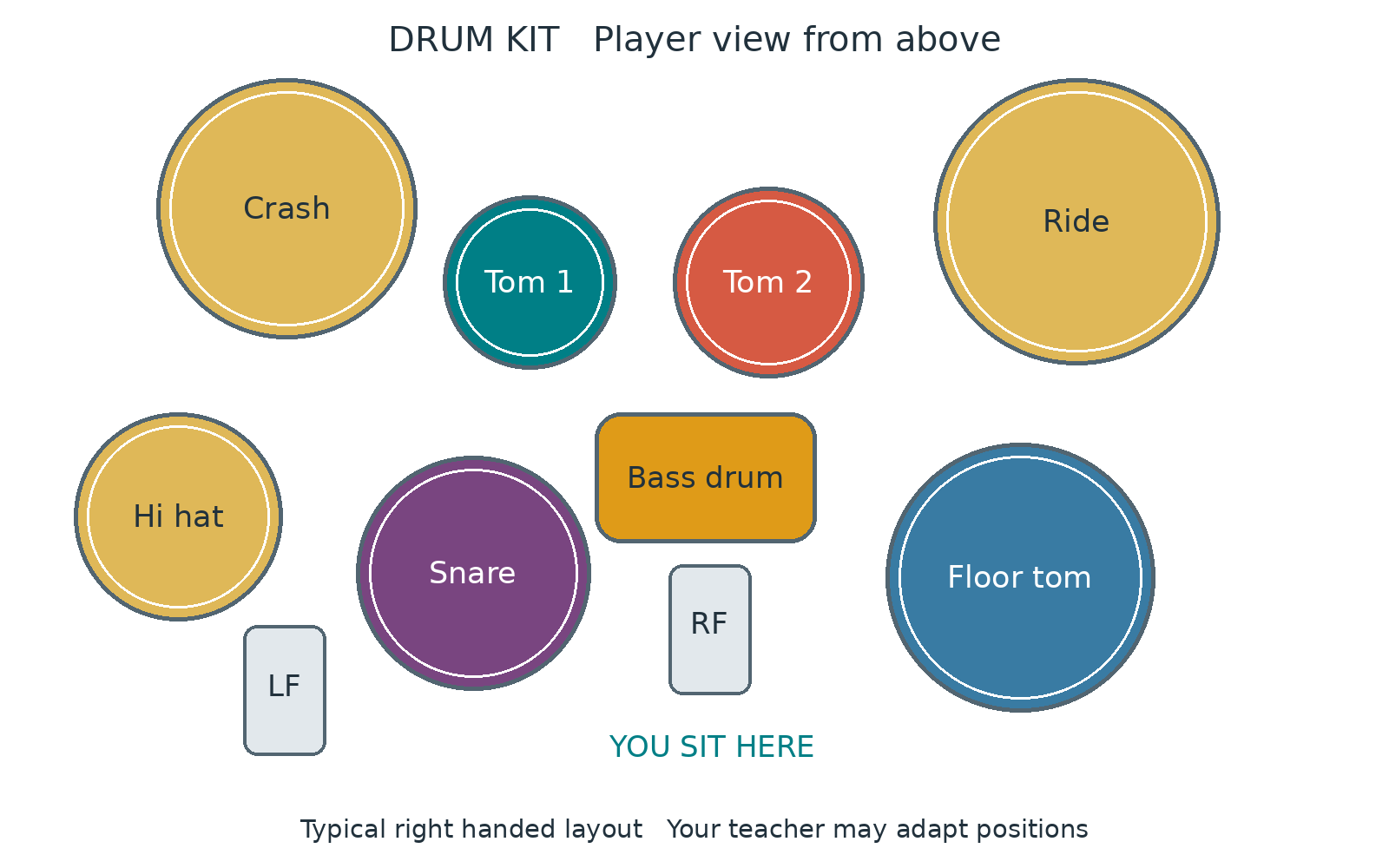
Player view means you look down from the drummer seat. Right foot uses the bass pedal. Left foot closes the hi hat in these starter grooves.
This is one right handed layout. Your teacher may change it for handedness, instrument size or access needs.
Read the rhythm symbols
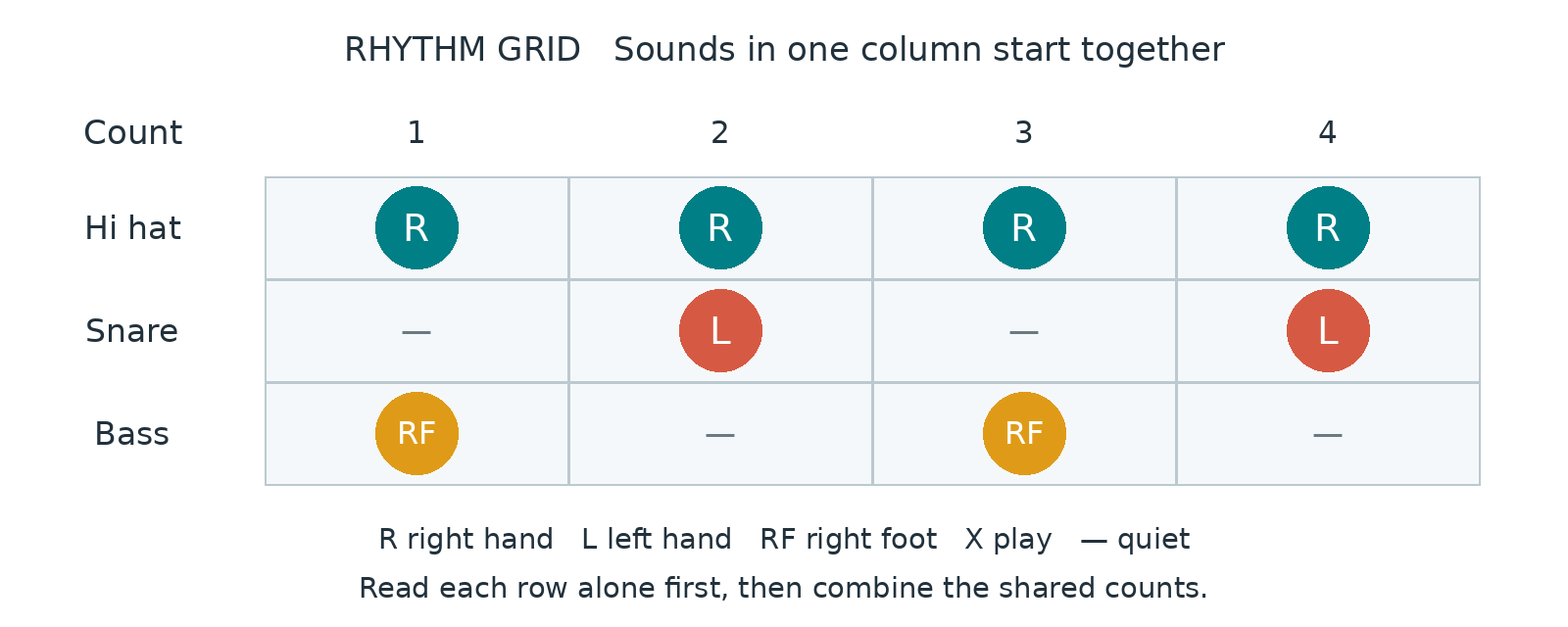
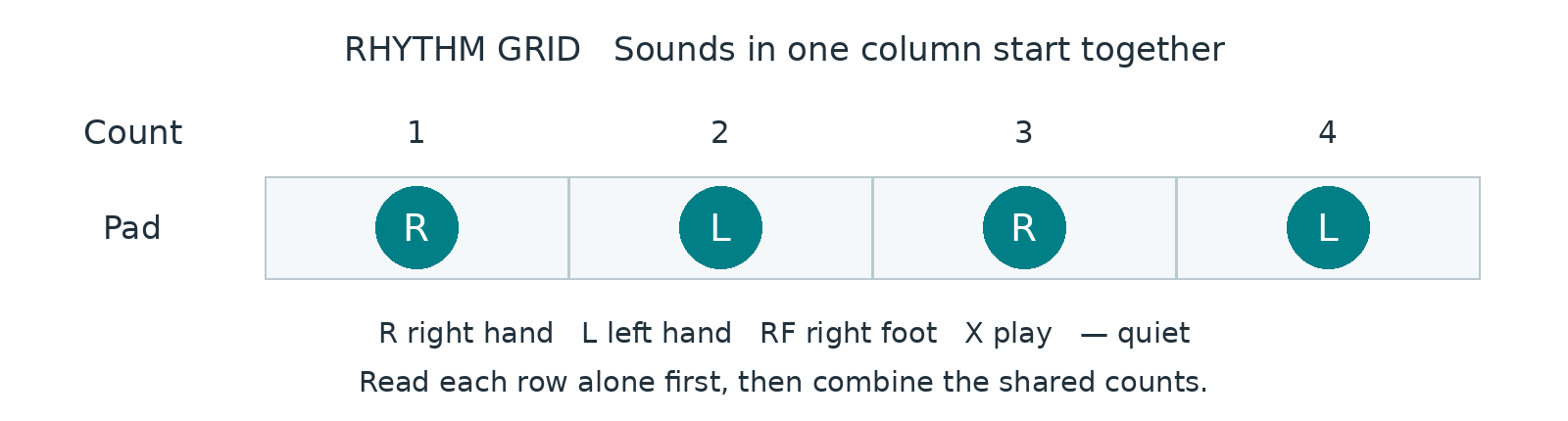
R = right hand. L = left hand. RF = right foot. X = play the named percussion sound. A dash means quiet. Hi hat closure uses the left foot but is not repeated in these grid rows.
Four columns count 1 2 3 4. Eight count 1 and 2 and 3 and 4 and. Sixteen divide each beat into 1 e and a. Three columns count 1 2 3.
LESSON 01 • LOOK AND TRY
Meet the drum family
Find instruments that make different kinds of sound.
1. Point to the snare, bass drum, toms and cymbals.
2. A drum kit combines several percussion instruments for one player.
3. A practice pad lets you learn stick control quietly.
Listen: Different surfaces have different tone colors.
Check: Keep a comfortable pace and relaxed movement. Ask for help when needed.
LESSON 01 • PLAY AND CHECK
Try it yourself
1. Name three parts of a kit.
2. Compare a drum head with a cymbal.
3. Draw the instrument you will practice on.
Ready for more? Find a shaker or tambourine and describe its sound.
School connection: Describing sounds practices clear language.
○ I tried it ○ I can show it ○ I want help
One thing I noticed: __________________________
My next small step: ___________________________
LESSON 02 • LOOK AND TRY
Protect your hearing
Make sound care part of every session.
1. Ask an adult to help choose and fit suitable hearing protectors for loud drumming.
2. Use quiet practice pads and comfortable electronic drum volume.
3. Take quiet breaks and tell an adult about ringing or muffled hearing.
Listen: You do not need loud playing to learn a clear rhythm.
Check: Keep a comfortable pace and relaxed movement. Ask for help when needed.
End of your free sample
You have read the free sample of Drums and Percussion for Students (11 of 104 pages).
Buy the complete book as a PDF download for $7.99 (USD). Secure checkout with Stripe; your download opens right after payment and a receipt is emailed to you.