Free sample · first 11 of 104 pages
Look Listen Play
Bass Guitar for Students
A colorful practical beginner workbook
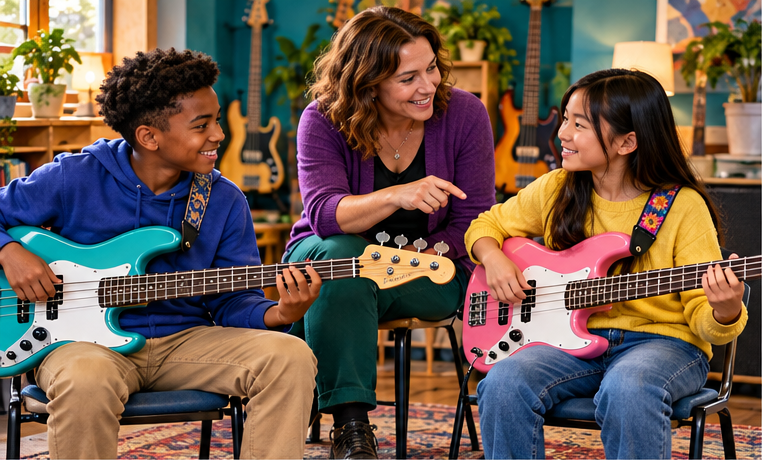
Hold • Find notes • Pluck • Groove
NISMCAA | Book 10
Standard four-string fretted electric bass
Your bass journey
The bass gives music a low foundation. In this book you will make clear sounds, learn string and fret locations, keep a steady beat and create your own bass lines.
Learn with a music teacher or a helpful adult. Take one small step at a time. The colorful scenes show playing situations; the exact maps show note locations.
My name: __________________________________
My school: __________________________________
My teacher: _________________________________
My first goal: _________________________________
How to use your book
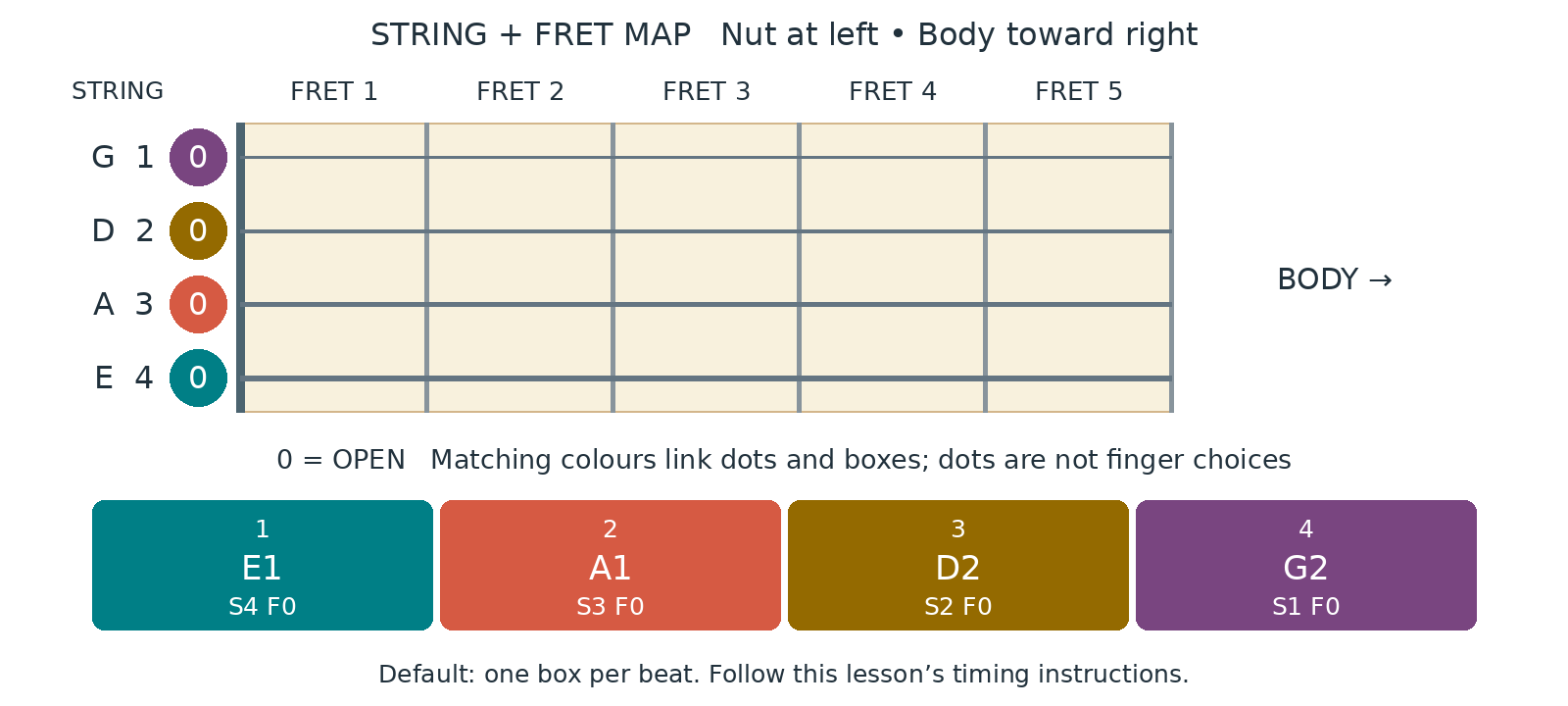
1. LOOK at the picture and find the same place on your bass.
2. TRY the three teaching steps slowly.
3. LISTEN for the sound described.
4. PRACTICE the facing page and show your teacher.
Rest your hands between short practices. Stop if you feel pain or numbness and ask an adult for help. A teacher can adapt instrument size, posture, fingering and tasks.
Your lesson route
Each lesson has a teaching page and a practice page. Tick a lesson when you can demonstrate its skill.
○ 01 Meet the bass · 9
○ 02 Choose your learning bass · 11
○ 03 Explore the parts · 13
○ 04 Set up your sound · 15
○ 05 Hold the bass seated · 17
○ 06 Stand with a strap · 19
○ 07 Give each hand a job · 21
○ 08 Learn E A D G · 23
○ 09 Tune with an adult · 25
○ 10 Make your first pluck · 27
○ 11 Alternate two fingers · 29
○ 12 Stop unwanted ringing · 31
○ 13 Find the steady pulse · 33
○ 14 Read bass tab · 35
○ 15 Play the open E string · 37
○ 16 Play the open A string · 39
○ 17 Play the open D string · 41
○ 18 Play the open G string · 43
○ 19 Press behind the fret · 45
○ 20 Name your fretting fingers · 47
○ 21 Find G on the E string · 49
○ 22 Find B on the A string · 51
Reference and writing pages begin on page 97.
Your next lessons
Each lesson has a teaching page and a practice page. Tick a lesson when you can demonstrate its skill.
○ 23 Find C on the A string · 53
○ 24 Find D in two places · 55
○ 25 Find E on the D string · 57
○ 26 Find F beside E · 59
○ 27 Give a note its length · 61
○ 28 Play even eighth notes · 63
○ 29 Meet the bass clef · 65
○ 30 Hear an octave · 67
○ 31 Understand fret steps · 69
○ 32 Play the C major scale · 71
○ 33 Follow a chord root · 73
○ 34 Make a four-chord bass line · 75
○ 35 Add a root and fifth · 77
○ 36 Build a repeating groove · 79
○ 37 Explore your tone · 81
○ 38 Control loud and soft · 83
○ 39 Play with a drummer · 85
○ 40 Compose your bass line · 87
○ 41 Prepare a short performance · 89
○ 42 Care for your bass · 91
○ 43 Solve a playing problem · 93
○ 44 Choose your next musical goal · 95
Reference and writing pages begin on page 97.
See the playing position
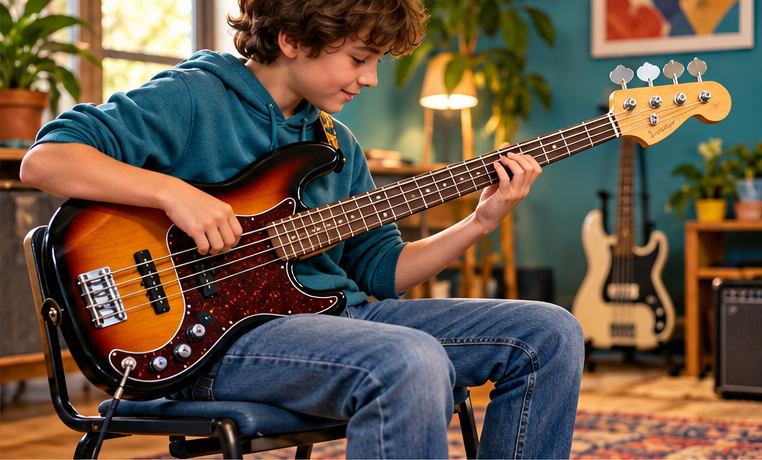
SIDE VIEW: feet supported, neck slightly raised, shoulders relaxed. The bass and strap support the weight.
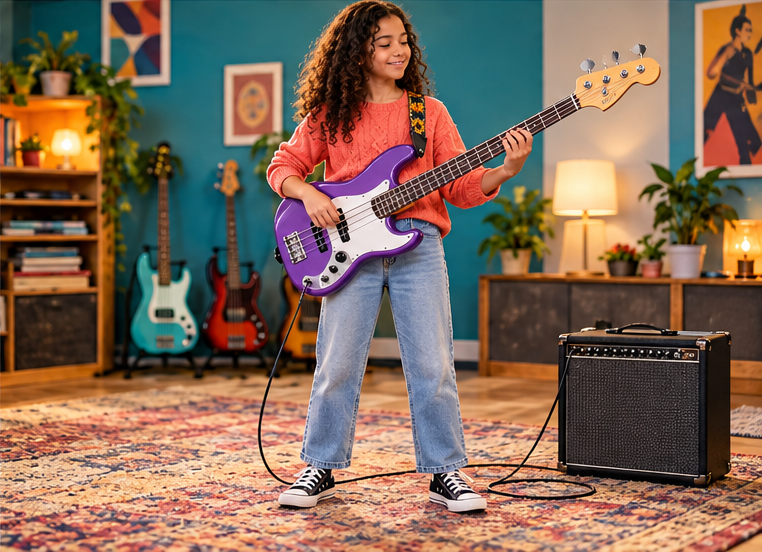
STANDING VIEW: secure strap, comfortable reach and balanced feet. An adult keeps cables clear of walking routes.
Look at the hands
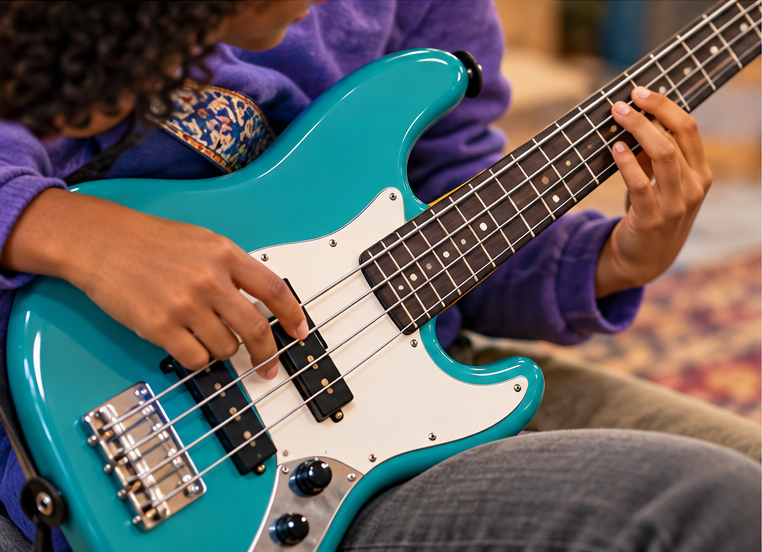
PLUCKING HAND: index and middle fingers take turns drawing gently through the string. Ask your teacher to show thumb support and muting.
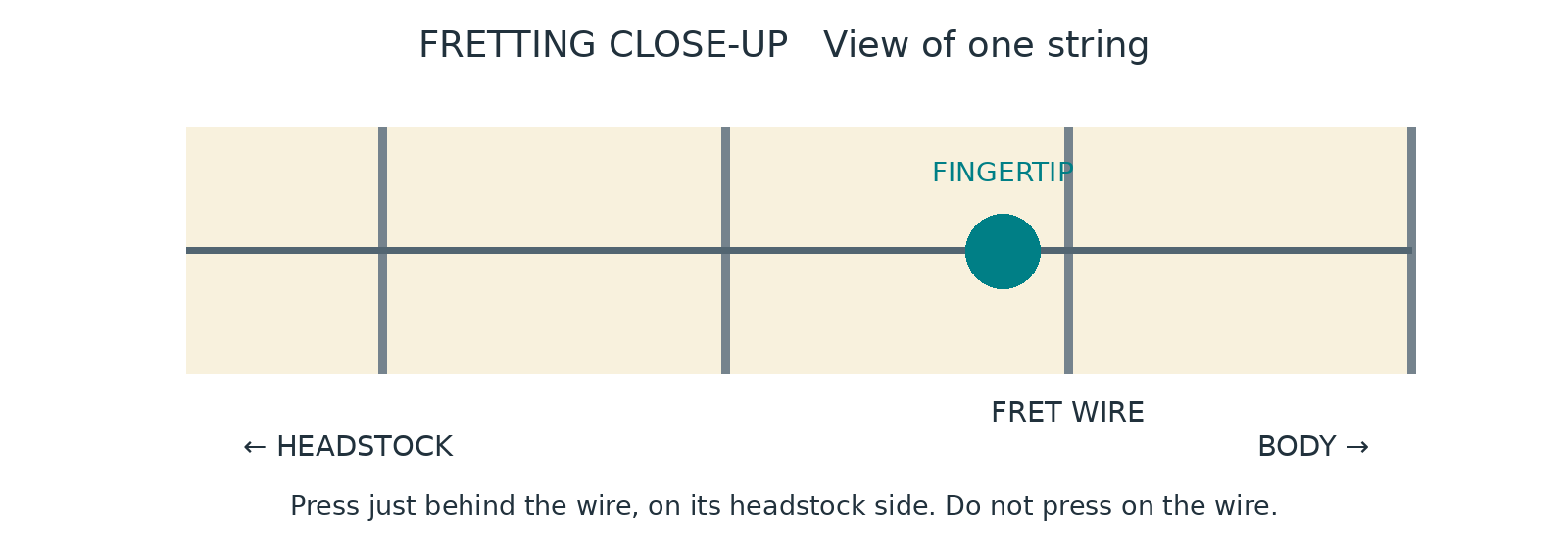
FRETTING HAND: place the fingertip just behind the metal wire, on the headstock side. The thumb supports gently behind the neck.
Read your visual maps
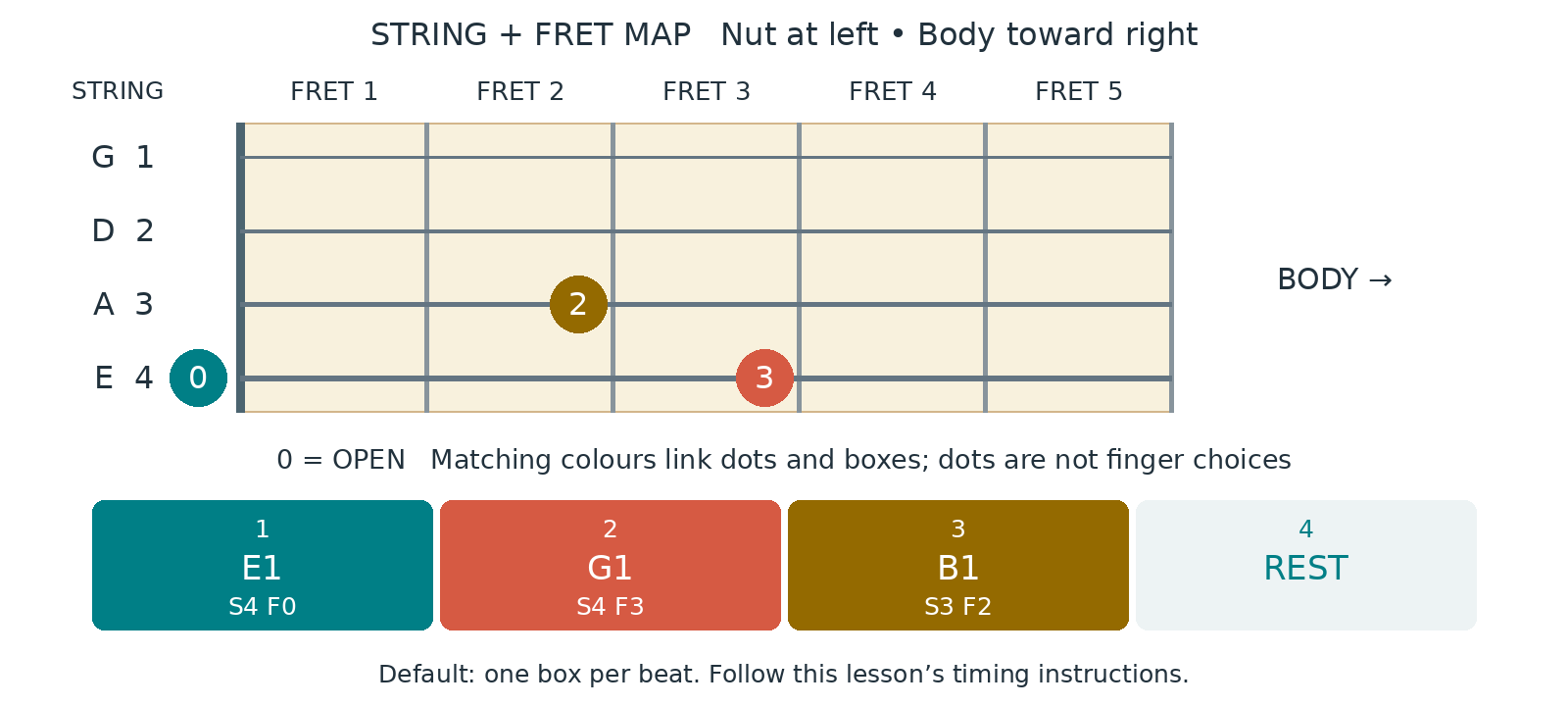
1. The top string in the map is thin G
2. the bottom is thick E.
3. S means string and F means fret. A colored 0 is an open string.
4. Read the boxes left to right. REST means silence, with the beat still going.
Note labels such as G1 or B1 show sounding pitch and octave. The dots locate notes; they do not prescribe fingers. Follow each lesson’s timing instruction.
LESSON 01 • LOOK AND TRY
Meet the bass
Hear how a bass supports a song.
1. Listen to your teacher play a low bass line.
2. Clap the beat while the bass repeats.
3. Notice how the low notes support the other sounds.
Listen: A clear low sound under a steady beat.
Check: play slowly and ask your teacher to check your sound and comfort.
LESSON 01 • PLAY AND CHECK
Try it yourself
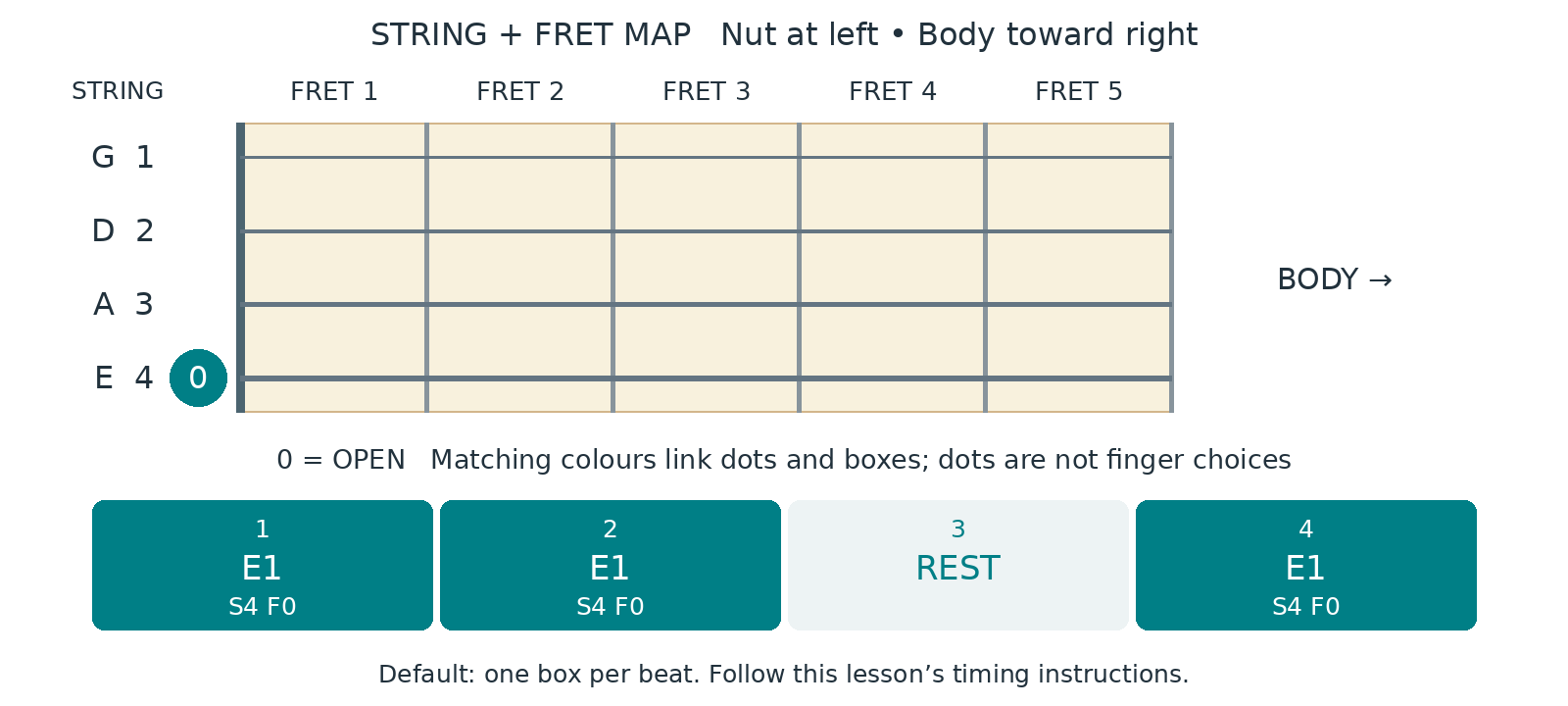
1. Say bass and describe its sound.
2. Clap four equal beats twice.
3. With help, pluck the open E string on each beat.
Ready for more? Explain how a bass and a singing voice can work together.
School connection: Naming parts and explaining sounds practices descriptive language.
○ I tried it ○ I can show it ○ I want help
One thing I noticed: __________________________
My next small step: ___________________________
LESSON 02 • LOOK AND TRY
Choose your learning bass
Find a comfortable four-string instrument.
1. Count four strings and four tuning machines.
2. Ask a teacher to check weight, reach and strap length.
3. Try a suitable short-scale bass if the usual size is difficult.
Listen: Each open string has its own pitch.
Check: play slowly and ask your teacher to check your sound and comfort.
End of your free sample
You have read the free sample of Bass Guitar for Students (11 of 104 pages).
Buy the complete book as a PDF download for $7.99 (USD). Secure checkout with Stripe; your download opens right after payment and a receipt is emailed to you.